Artificial intelligence is becoming part of everyday work, content creation, education, business, and digital productivity. But for someone completely new to AI, the number of tools and technical terms can make getting started feel unnecessarily complicated.
That is where Generative AI Essentials for Beginners aims to help.
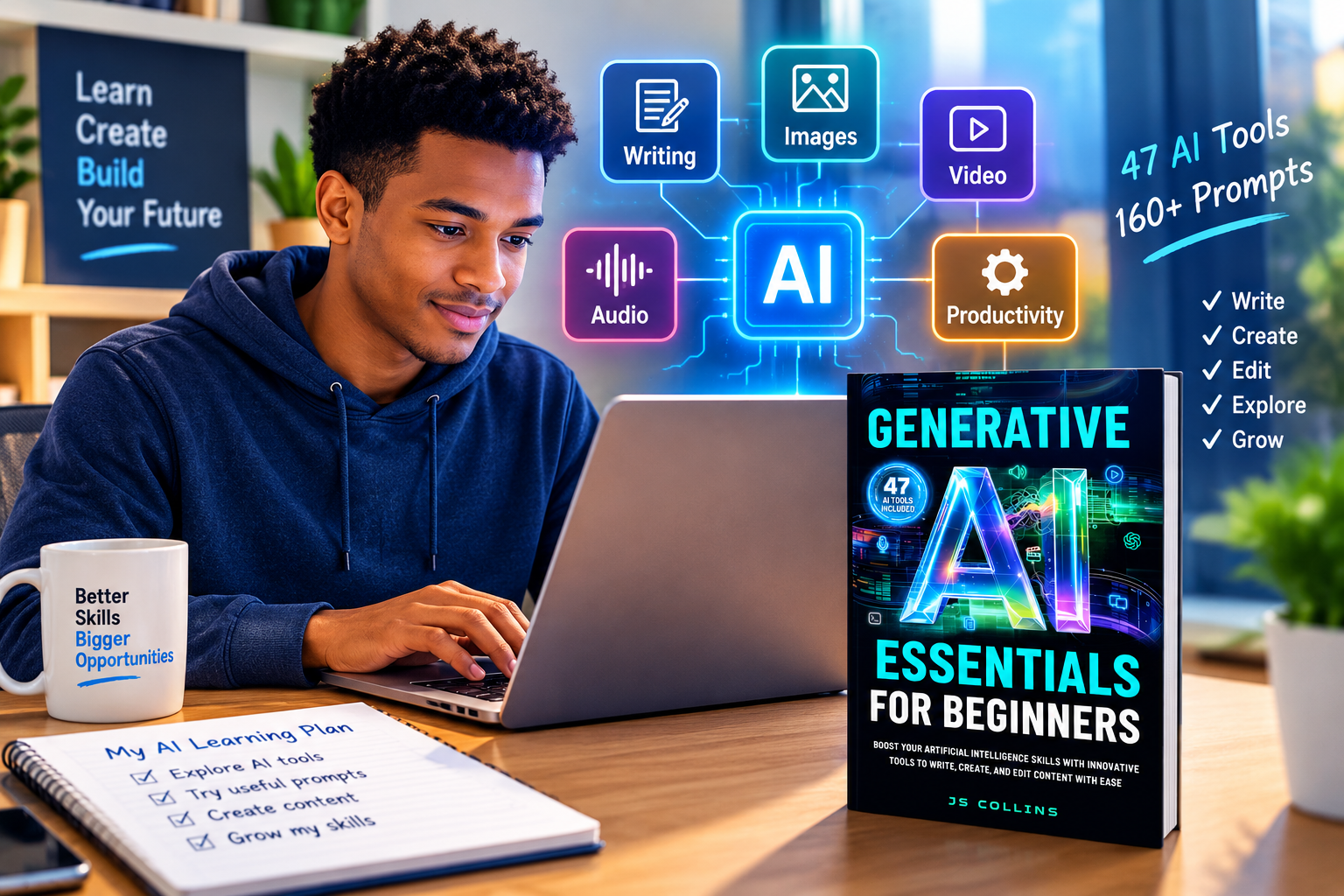
Written by JS Collins, this beginner-focused book introduces readers to generative AI, practical AI tools, and ready-to-use prompts without requiring advanced technical knowledge. The book is described as a hands-on guide covering 47 AI tools and more than 160 prompts for writing, creating, researching, designing, and improving productivity.
But is this book suitable for someone who is just beginning to explore artificial intelligence?
In this guide, we will look at what the book covers, who it is designed for, its potential strengths and limitations, pricing information, alternatives, practical use cases, and the questions you may want answered before buying.
Quick Answer
Generative AI Essentials for Beginners is a beginner-oriented AI book designed to introduce readers to generative AI tools, prompts, and practical applications.
It may be particularly relevant if you want a non-technical introduction to AI and are interested in using AI for writing, content creation, productivity, research, social media, business, or creative projects.
The book includes information about 47 beginner-friendly AI tools and 160+ prompts, according to current product descriptions.
If your main goal is to understand practical AI applications without starting with programming or advanced theory, this book is worth investigating.
What Is Generative AI Essentials for Beginners?
Generative AI Essentials for Beginners is a practical introduction to artificial intelligence and generative AI created for readers who may have little or no previous technical experience.
The author is listed as JS Collins, and the book is independently published. Current listings identify it as a 186-page English paperback published in November 2025.
Rather than focusing exclusively on technical concepts, the book is positioned around practical applications.
The areas described include:
- AI writing
- Content creation
- Image generation
- Video and audio tools
- Productivity
- Research
- Blogging
- Social media
- Creative projects
- Business applications
- AI prompts
- Understanding AI trends and risks
This approach makes the book more relevant to people who want to learn how to use AI, rather than only learning how AI systems work technically.
What Does the Book Teach?
The book focuses on several important areas of beginner AI education.
1. Understanding Generative AI
One of the first challenges for beginners is understanding what generative AI actually means.
Generative AI refers to AI systems capable of producing new content, such as text, images, audio, video, or other forms of output based on user instructions.
For a beginner, understanding this basic concept is important because it provides context for everything else.
2. Exploring AI Tools
The book introduces 47 AI tools across different categories.
Instead of learning one application and stopping there, readers are introduced to a broader AI ecosystem.
This can be useful because different tools are designed for different tasks.
For example, one platform may be more suitable for writing, while another may be designed for image generation, video, audio, research, or productivity.
3. Using AI Prompts
Another major component is the collection of 160+ ready-to-use prompts.
Prompts are instructions given to an AI system to produce a desired response.
For beginners, learning how to communicate effectively with AI can be just as important as choosing the right tool.
A well-structured prompt can provide the AI with:
- A clear objective
- Relevant context
- Desired format
- Target audience
- Tone
- Constraints
- Expected output
The book’s focus on practical prompts therefore gives beginners something they can potentially apply immediately.
How Can a Beginner Use the Book?
A simple learning process could look like this:
Step 1: Understand the basics
Start by learning the fundamental concepts of artificial intelligence and generative AI.
Step 2: Explore different tools
Instead of trying dozens of platforms randomly, use the book’s tool-focused material to understand different categories and possible applications.
Step 3: Practice with prompts
Use the included prompts as starting points and gradually modify them for your own needs.
Step 4: Apply AI to real tasks
Try AI with tasks you already perform, such as drafting emails, generating ideas, researching topics, creating social media content, or organizing information.
Step 5: Develop your own workflow
The long-term value of learning AI comes from integrating useful tools into your existing workflow rather than simply collecting a list of AI applications.
Key Features
47 AI Tools
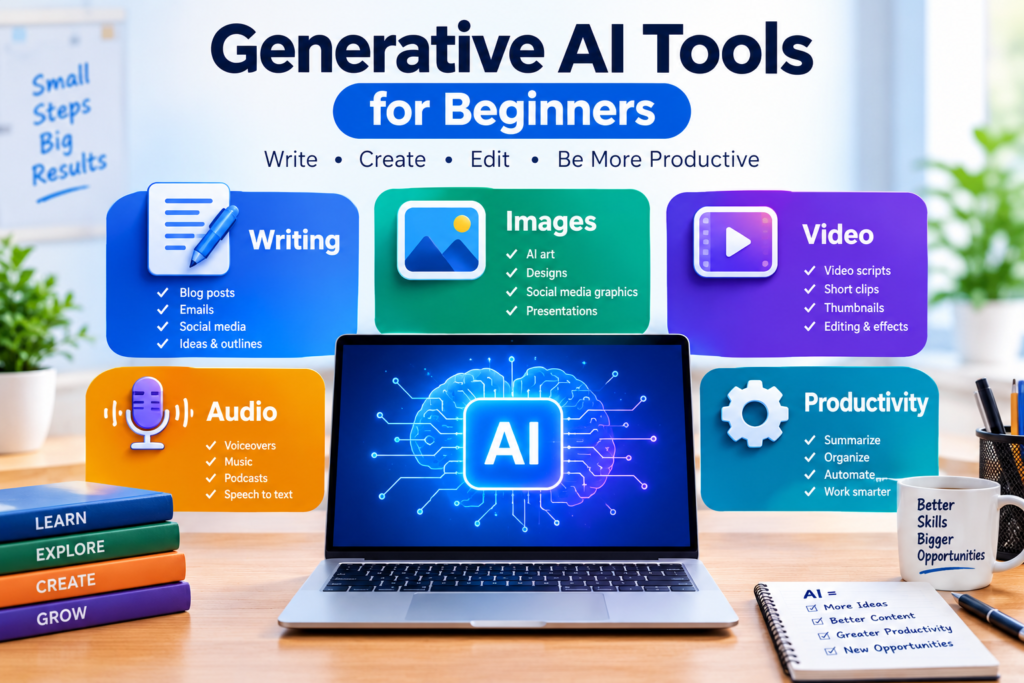
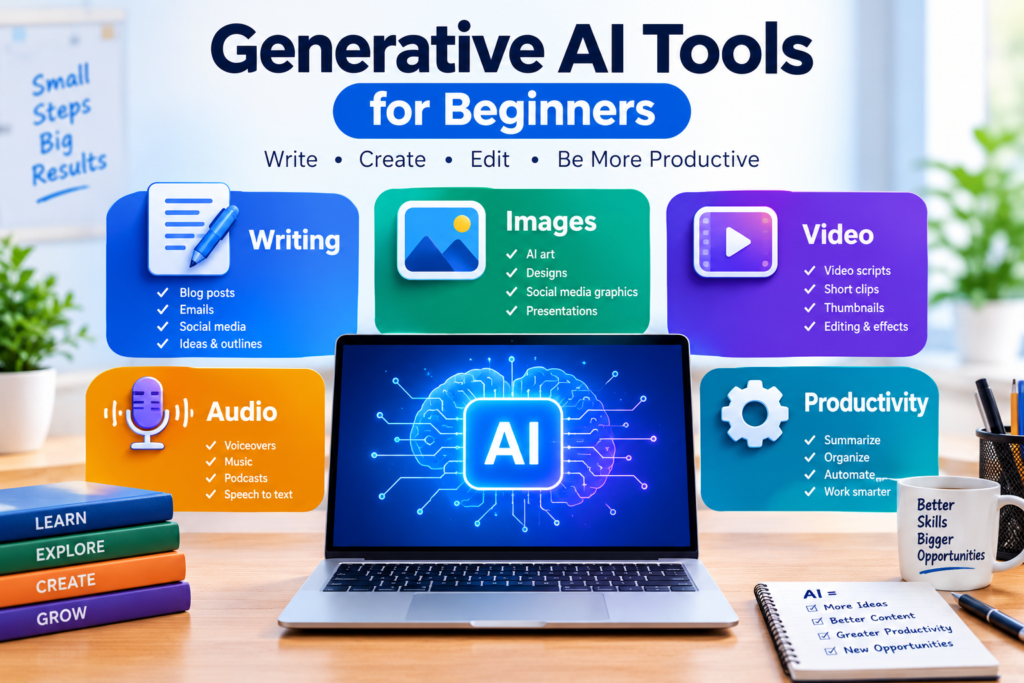
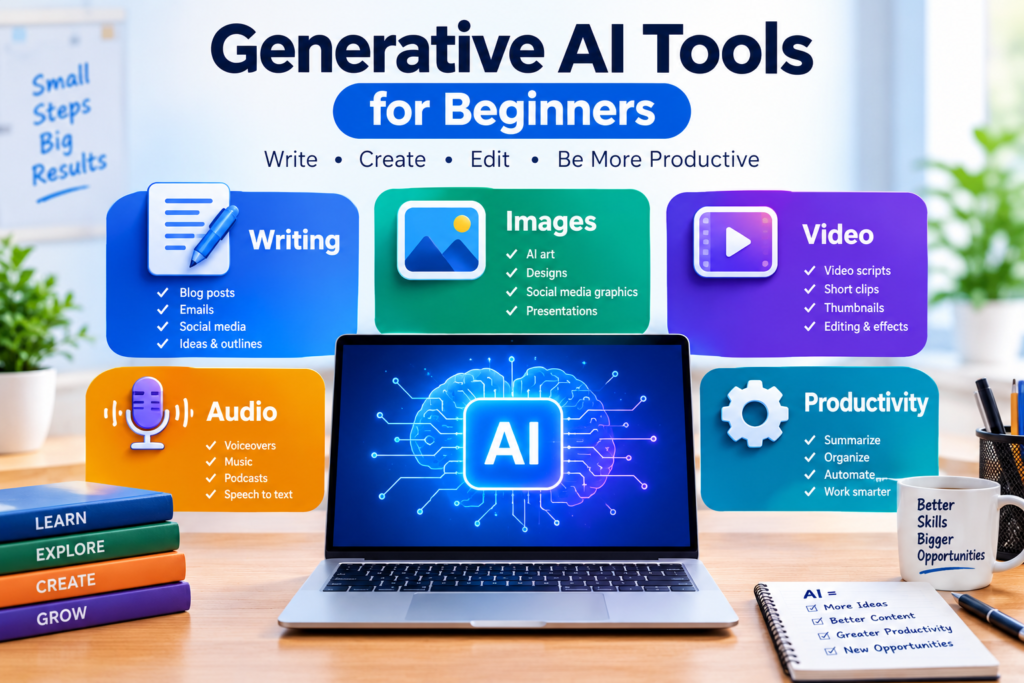
The book introduces 47 AI tools across writing, design, video, audio, and productivity.
Why it matters: Beginners often struggle to know which AI tools exist and what each category is used for. A broad introduction can help readers discover options without searching for every tool independently.
160+ Ready-to-Use Prompts
The book includes more than 160 prompts.
Why it matters: Beginners may understand what AI can do but still struggle with what to type. Practical prompts can give them a starting point.
Beginner-Friendly Explanations
The book is positioned for readers without advanced technical knowledge.
Why it matters: Someone learning AI for the first time generally benefits from explanations that focus on practical examples instead of unnecessary technical terminology.
Practical Applications
The book discusses applications involving writing, blogging, email, social media, creative work, research, business, and productivity.
Why it matters: Readers can connect AI concepts to tasks they already perform.
Main Benefits
The potential benefits of this type of guide include:
- Building a basic understanding of generative AI
- Discovering multiple AI tools
- Learning practical prompting techniques
- Finding applications for AI in everyday work
- Exploring AI for content creation
- Understanding how AI can support productivity
- Learning about AI applications without starting with programming
The important distinction is that the book provides guidance and examples; it does not guarantee that every reader will achieve a particular productivity or financial result.
Pros and Cons
Pros
- Designed for beginners
- Covers multiple AI tool categories
- Includes 160+ prompts
- Focuses on practical applications
- Covers writing, content, design, video, audio and productivity
- Useful for readers who do not want a highly technical introduction
Cons
- AI tools change rapidly, so some tool information may become outdated
- Readers looking for advanced AI engineering will need more specialized resources
- A broad overview of many tools may not provide deep instruction on every individual platform
- Availability and pricing of individual AI tools can change over time
The last two points are particularly important. AI is a rapidly changing field, so a book should be viewed as a foundation rather than a permanent directory of every current AI platform.
Pricing and Availability
Current retailer listings show the paperback at around $14.95, although prices can vary by retailer, country, promotions, and availability.
For example, Bookshop.org currently lists the paperback at $14.95, while Books-A-Million also lists it at $14.95.
Because book prices and availability can change, readers should check the current Amazon listing before purchasing.
Check the latest price and availability
Who Is Generative AI Essentials for Beginners Best For?
Beginners
This is the clearest target audience. If you are completely new to generative AI, the book’s introductory approach may make the subject easier to approach.
Writers and Content Creators
People working with articles, blogs, social media content, ideas, and other written material may find the practical AI-tool approach relevant.
Students
Students interested in understanding modern AI tools can use the book as an introductory resource.
AI should still be used responsibly in academic environments, especially where schools or universities have specific rules regarding AI-generated work.
Freelancers
Freelancers can explore AI applications for research, brainstorming, writing, communication, and other administrative tasks.
Entrepreneurs and Small-Business Owners
Business owners interested in using AI for content, productivity, marketing ideas, research, or creative work may find the practical orientation useful.
Professionals
Professionals who want to become more familiar with modern AI tools without learning programming may also benefit.
Who Is It Not Best For?
This book may not be the right resource if you are specifically looking for:
- Advanced machine-learning mathematics
- AI model development
- Deep learning engineering
- Python-based AI programming
- Advanced data science
- Training your own large language model
- Highly specialized AI engineering
Those subjects require more technical resources.
The book is better understood as a practical beginner’s guide, not an advanced computer-science textbook.
Real-World Use Cases
Creating Blog Content
A beginner could use AI tools to brainstorm article topics, create outlines, improve drafts, or generate alternative headlines.
Human editing and fact-checking remain important because AI-generated information can contain errors.
Social Media
AI can help generate content ideas, captions, hooks, and variations for different platforms.
For marketers and creators, the important skill is learning how to provide enough context so the generated content matches the brand and audience.
Email Writing
AI tools can assist with drafting professional emails, summarizing information, or adapting a message to a particular tone.
Research and Planning
AI can help organize ideas, create research questions, summarize provided information, and structure plans.
However, important factual claims should be verified against reliable sources.
Creative Projects
AI tools can support brainstorming, image creation, video concepts, audio projects, and other creative workflows.
The best results usually come when AI is treated as a tool supporting human direction rather than as a replacement for human judgment.
Generative AI Essentials for Beginners vs. Other AI Resources
| Factor | Generative AI Essentials for Beginners | AI Tool Documentation | Advanced AI Courses |
|---|---|---|---|
| Beginner friendly | Yes | Varies | Varies |
| Multiple tools | Yes | Usually one tool | Depends on course |
| Ready-to-use prompts | 160+ | Usually limited | Depends |
| Technical depth | Introductory | Tool-specific | Often deeper |
| Practical focus | High | Varies | Varies |
| Best for | AI beginners | Specific tool users | Deeper learners |
There is no single resource that is best for every learner.
A beginner may benefit from a broad introductory book first and then move to official documentation or specialized courses once they know which AI areas interest them.
Alternatives to Consider
Official AI Tool Documentation
If your goal is to master one particular AI platform, its official documentation and tutorials can be more current than a general-purpose book.
Best for: People who already know which AI tool they want to learn.
Main advantage: Information can be updated as the platform changes.
Main limitation: Documentation can be less beginner-friendly than a structured book.
Specialized AI Courses
An online course can provide structured lessons, exercises, and demonstrations.
Best for: Learners who prefer video-based or step-by-step instruction.
Main advantage: More interactive learning.
Main limitation: Quality, depth, and pricing vary significantly between courses.
Free AI Tutorials
There are many free articles, videos, and official resources covering generative AI.
Best for: Readers who want to learn without purchasing a book.
Main advantage: Low cost and frequently updated material.
Main limitation: Information can be fragmented, making it harder for beginners to build a structured learning path.
Is the Book Still Useful as AI Changes Quickly?
This is one of the most important questions to ask.
AI technology changes extremely quickly. New models, platforms, features, pricing structures, and capabilities appear regularly.
That means a book published in 2025 cannot guarantee that every tool or feature it discusses will remain exactly the same.
However, foundational skills can remain useful.
For example, learning how to:
- evaluate AI tools,
- write clear prompts,
- check AI-generated information,
- protect sensitive information,
- compare different tools,
- and integrate AI responsibly into a workflow
can remain valuable even when specific platforms change.
For that reason, the strongest way to use a book like this is as a foundation for AI literacy, while checking official websites for the latest tool features and pricing.
Frequently Asked Questions
Is Generative AI Essentials for Beginners suitable for complete beginners?
Yes. The book is specifically positioned as a beginner-friendly introduction and does not require advanced technical experience.
Does the book teach ChatGPT?
The book’s description mentions ChatGPT among the modern AI platforms discussed, alongside tools such as Claude, Gemini, Canva AI, and DALL-E.
How many AI tools are included?
The book is described as covering 47 AI tools across writing, design, video, audio, and productivity.
How many prompts are included?
The book description states that it contains more than 160 ready-to-use prompts.
Do I need coding experience?
The book is designed for beginners and focuses on practical AI use rather than requiring programming knowledge.
Can writers use this book?
Yes. Writing and content creation are among the practical applications discussed in the book.
Can entrepreneurs use it?
Yes. The book includes AI applications for business, productivity, content, and creative work.
Is this an advanced artificial intelligence textbook?
No. It is better categorized as an introductory practical guide rather than an advanced technical textbook.
Is the book available in paperback?
Yes. Current listings identify it as a 186-page paperback.
When was the book published?
Current retailer listings identify the publication date as November 11, 2025.
Can AI tools replace human creativity?
AI can assist with brainstorming and content generation, but human judgment, editing, originality, context, and decision-making remain important.
Should I verify information generated by AI?
Yes. AI systems can produce incorrect or outdated information. Important facts should be checked against reliable sources.
Final Verdict
Generative AI Essentials for Beginners is positioned as a practical starting point for people who want to understand and use generative AI without beginning with advanced technical material.
Its biggest strengths are its beginner-focused approach, broad introduction to AI tools, and collection of more than 160 prompts. The combination may be particularly useful for people interested in writing, content creation, productivity, research, creative work, or business applications.
Its main limitation is the rapidly changing nature of AI. Specific tools, features, interfaces, and prices can change after a book is published.
Therefore, the book makes the most sense as an introductory learning resource, while official documentation and current product websites should be used for the latest information.
If you are new to generative AI and want one structured resource covering multiple tools and practical prompts, this book is worth considering.
Check the current Amazon listing here:
https://tinyurl.com/yyrtucff
Affiliate Disclosure
This article may contain affiliate links. If you purchase a product through an affiliate link, DigitalAff.com may earn a commission at no additional cost to you. This does not change the price you pay, and our recommendations are based on the information available at the time of publication.
CTA Recommendations
Use 3–4 CTAs rather than placing one after every section:
- Check the Latest Price on Amazon
- Explore Generative AI Essentials for Beginners
- See What’s Included in the Book
- Start Learning Generative AI
Recommended primary CTA:
Ready to explore the book? Check the latest price and availability on Amazon.
Internal Link Recommendations
| Anchor Text | Suggested Page | Why It Should Be Linked |
|---|---|---|
| AI Business and Career Handbook | AI Business and Career Handbook article | Connects beginner AI learning with professional applications |
| AI tools for professionals | AI tools article | Supports readers researching practical AI tools |
| AI productivity tools | AI productivity article | Expands the productivity topic |
| AI for small business | AI business article | Helps entrepreneurs continue their research |
| Start Affiliate Marketing Like a Pro | Affiliate marketing article | Connects AI skills with online business |
| Digital products for beginners | Digital products article | Relevant to readers interested in digital business |
| Best AI tools for content creation | AI tools article | Natural continuation for content creators |
External Source Recommendations
For factual information that may change, link to authoritative sources such as:
- Amazon product listing
- Official websites of individual AI platforms
- Official documentation for AI tools mentioned in the article
- Relevant university or recognized technology resources when explaining AI concepts