If your child is fascinated by insects, leaves, rocks, flowers, coins, fabrics, or other tiny details, a traditional microscope isn’t the only way to introduce them to science.
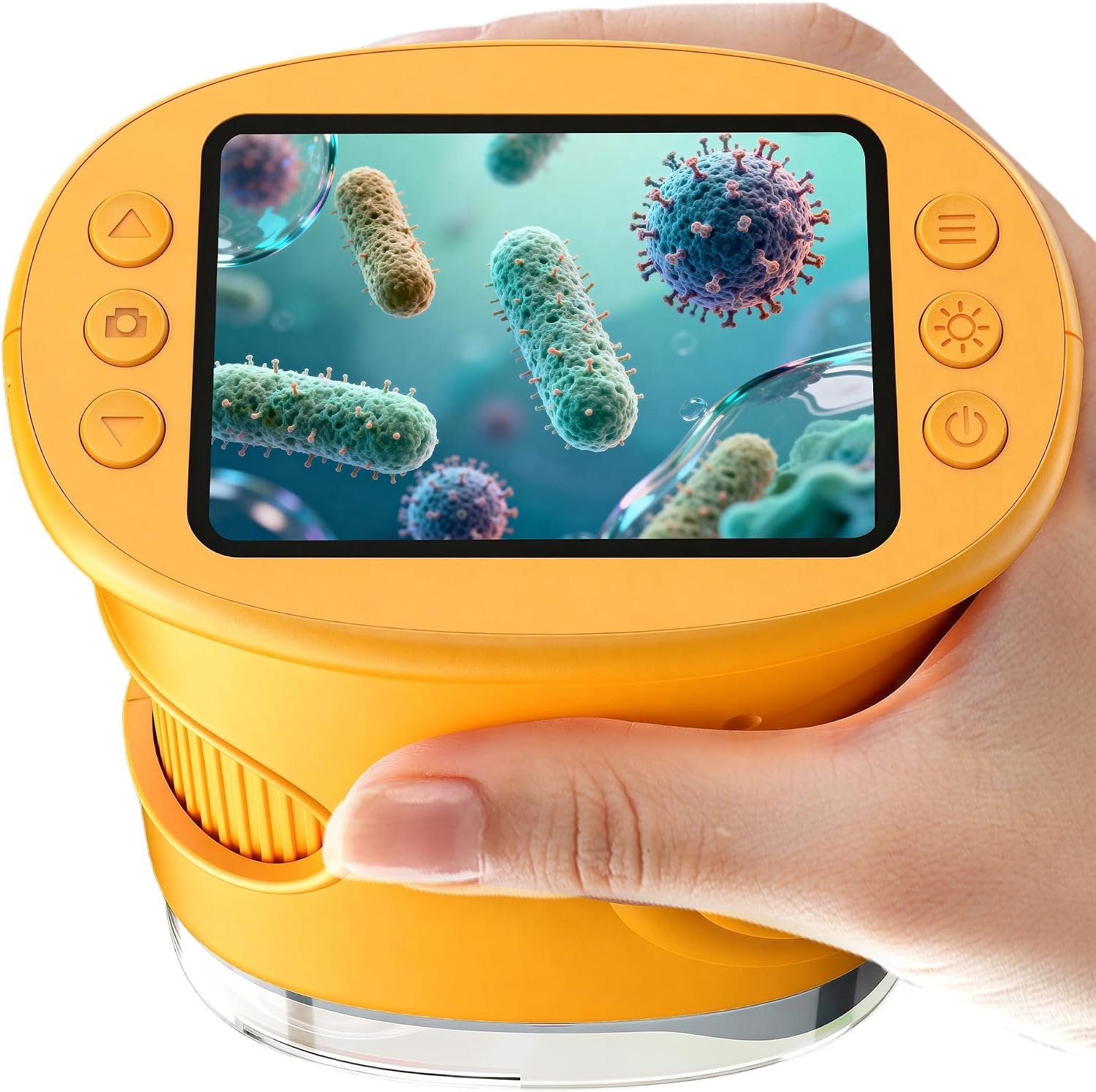
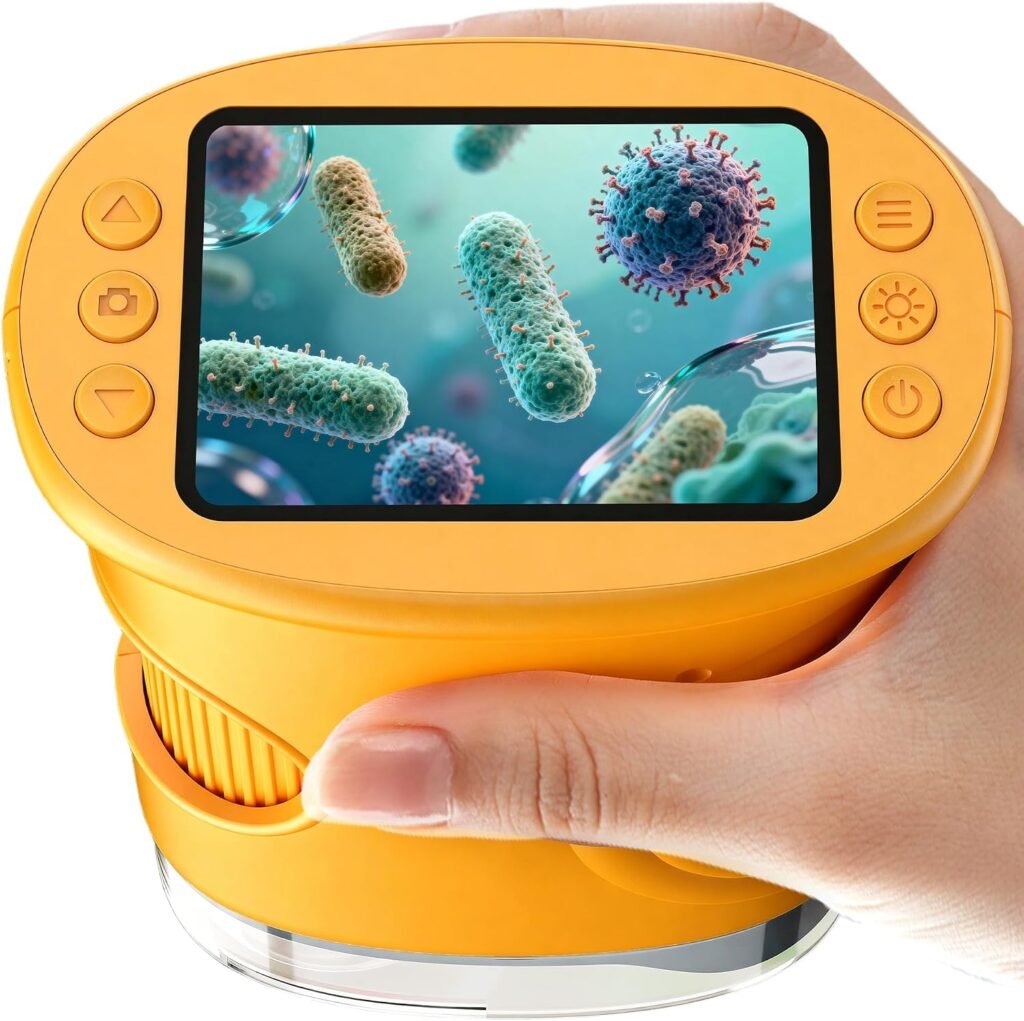
A 1000X handheld digital microscope for kids offers a simpler approach: children can hold the device, place it close to an object, adjust the focus, and view the enlarged image on a built-in screen.
The model discussed in this guide is a compact handheld microscope identified as model 382 and ASIN B0FFSSWTB6. Its listed specifications include up to 1000X magnification, a 2.0-inch IPS display, a 2MP camera, manual focus, eight adjustable LED lights, a rechargeable 600mAh battery and USB-C connectivity.
But specifications alone don’t tell you whether a microscope is actually suitable for your child.
This guide looks at what the microscope offers, what children can use it for, its advantages and limitations, how it compares with alternatives, and what parents should check before buying.
Quick Answer
The 1000X Handheld Digital Microscope for Kids is a compact digital microscope designed for close-up observation, nature exploration and hands-on science activities.
Its main attractions are the built-in 2.0-inch IPS screen, up-to-1000X magnification claim, 2MP camera, adjustable LED illumination, manual focus and rechargeable design.
It can be particularly interesting for children who enjoy discovering small details around them, but parents should remember that a high “1000X” number alone does not guarantee laboratory-level microscopic imaging. Actual image quality depends on focus, lighting, working distance, optics and the object being examined.
Check the latest Amazon price and current product details before ordering.
What Is the 1000X Handheld Digital Microscope for Kids?
The product is a portable digital microscope designed for children and students who want to examine small objects without using a conventional laboratory-style microscope.
Instead of requiring the user to look through a traditional eyepiece, the device uses a camera and displays the enlarged image on its built-in screen.
That makes the basic experience straightforward:
- Turn on the microscope.
- Position it close to the object.
- Adjust the manual focus.
- Use the LED lighting when necessary.
- Examine the enlarged image on the screen.
- Capture photos or videos when desired.
The product is marketed as a portable educational and STEM-oriented device, making it suitable for activities at home, outdoors or during science projects.
Key Features
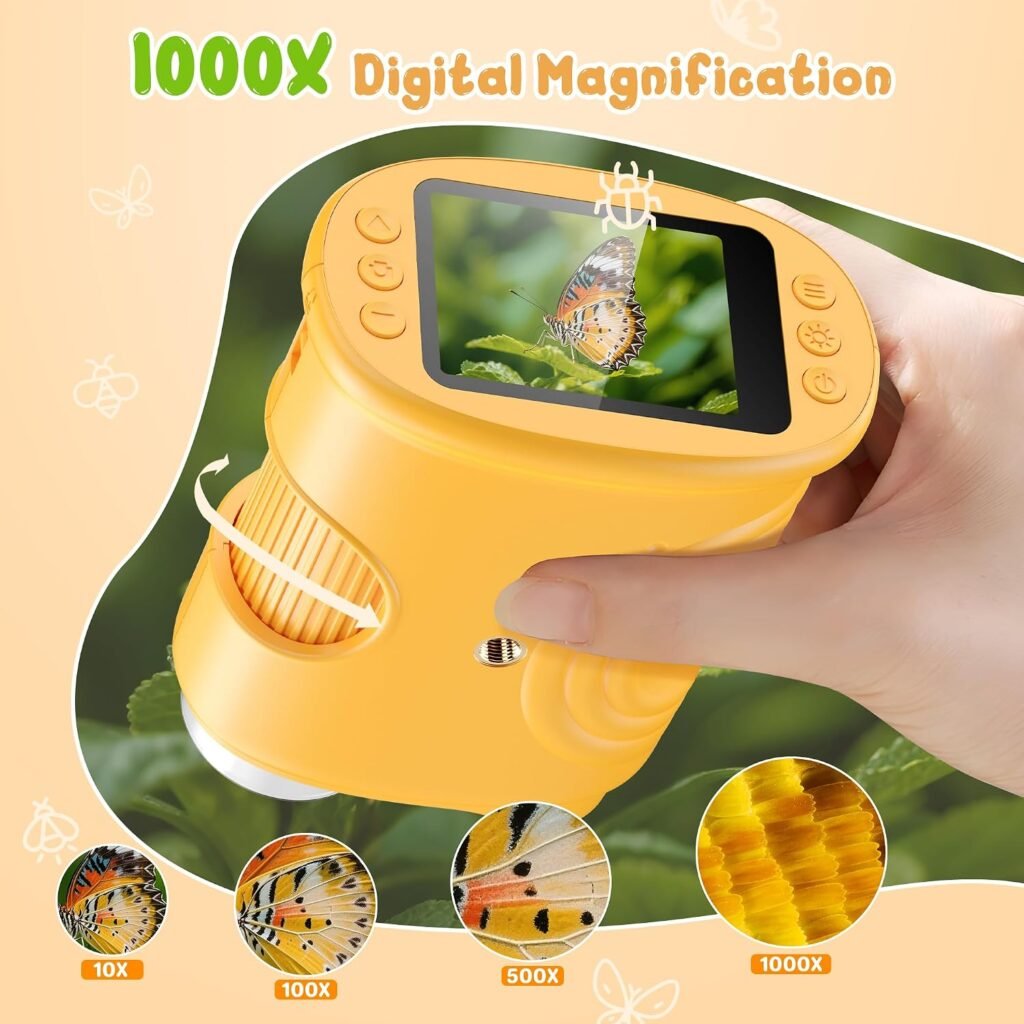
1. Up to 1000X Magnification
The headline feature is the claimed maximum magnification of 1000X.
Magnification allows an object to appear much larger on the display than it does to the naked eye.
For children, this can make ordinary objects more interesting. A leaf, piece of fabric, rock, feather or insect can become an opportunity for observation.
However, it’s important not to assume that 1000X automatically means laboratory-grade performance.
Digital microscope magnification numbers can include different combinations of optical and digital enlargement. The usefulness of the image depends on more than the number printed on the box.
For parents, image clarity and ease of use may matter more than maximum magnification alone.
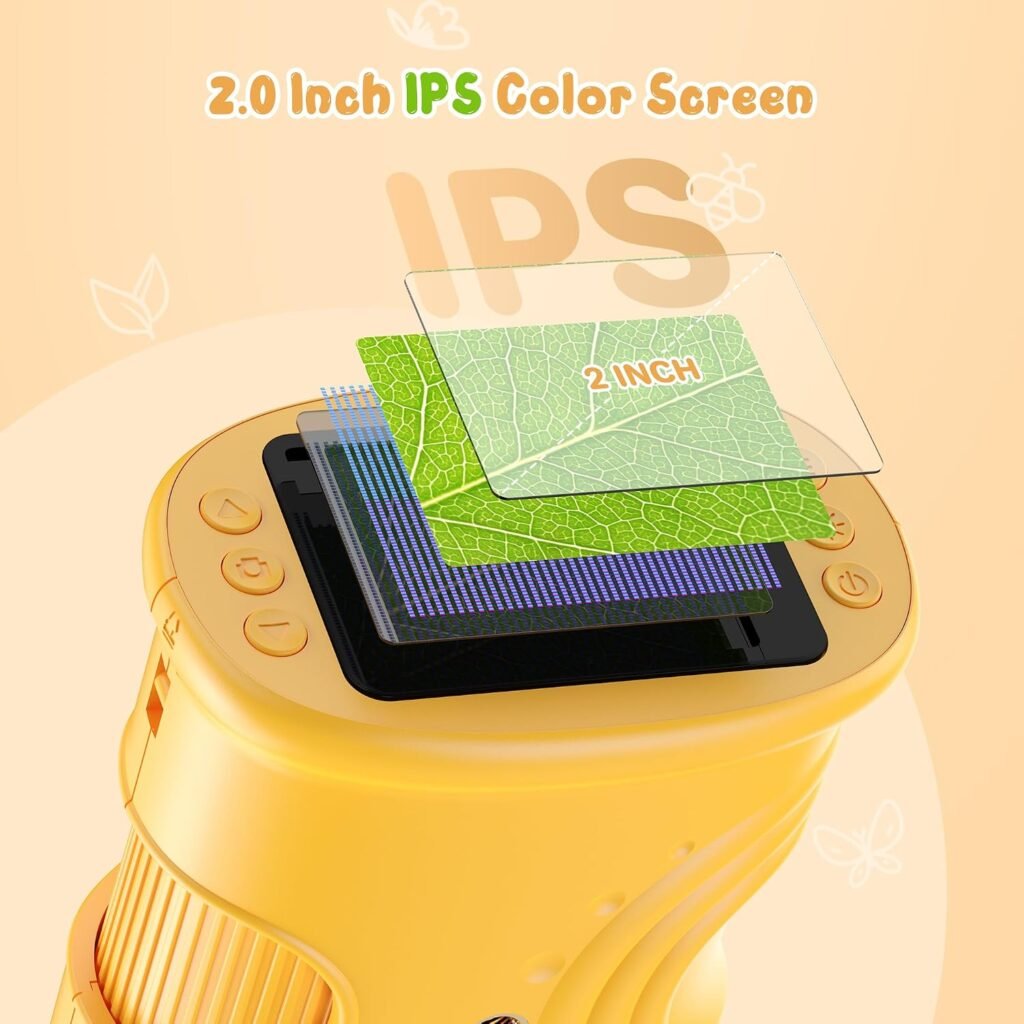
2. 2.0-Inch IPS Screen
The built-in 2.0-inch IPS display is one of the most practical features.
Children don’t have to position one eye against a tiny eyepiece. They can look at the screen while holding the microscope over the object.
This can make observation more accessible for younger users and can also make it easier for parents and children to look at the discovery together.
3. 2MP Camera
The microscope includes a 2MP camera according to the available product specifications.
This allows the device to capture images of observations rather than simply displaying them temporarily.
For educational activities, saved images can be useful for:
- Science projects
- Nature journals
- Classroom presentations
- Comparing different objects
- Recording discoveries
- Creating a simple observation portfolio
The actual image quality will depend on lighting, focus and the object being examined.
4. Manual Focus
The microscope uses manual focus.
This means the user needs to adjust the focus to make the subject appear clearer.
Manual focus can require a little practice, particularly for younger children.
However, it also gives the user more control over the viewing distance and image clarity than a completely fixed-focus toy.
Parents may want to help younger children initially learn how small focus adjustments change the image.
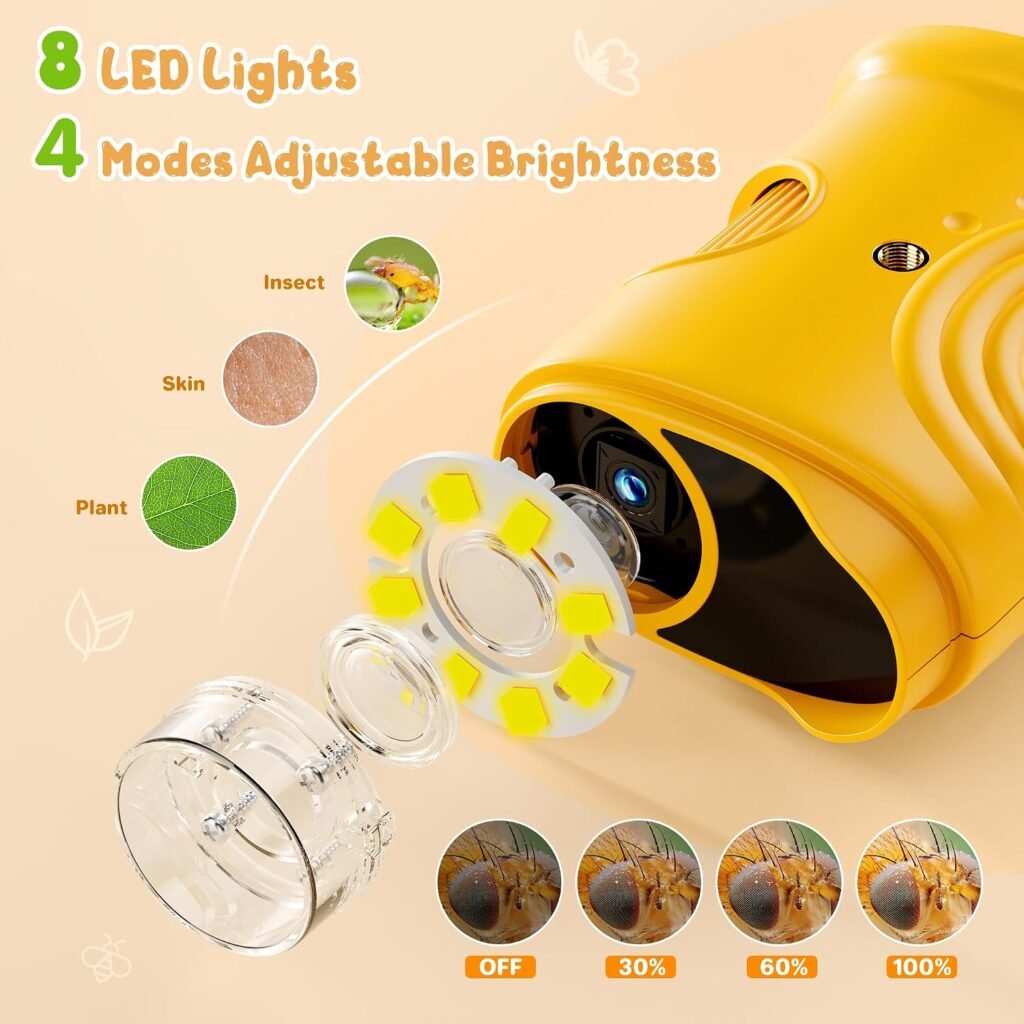
5. Eight Adjustable LED Lights
The built-in LED lights help illuminate the object being examined.
Lighting is especially useful when the object itself doesn’t provide enough contrast or when the microscope is being used indoors.
Different brightness levels can help the user adjust the amount of illumination depending on the subject.
This can be useful when examining:
- Leaves
- Rocks
- Insects
- Fabric
- Paper
- Coins
- Feathers
- Small household objects
Good lighting is an important part of getting a useful image from a digital microscope.
6. Rechargeable Battery
The product is listed with a 600mAh rechargeable battery.
A rechargeable design means parents don’t have to depend on replacing disposable batteries every time the device needs power.
The microscope can be charged through USB-C according to the available specifications.
Battery runtime can vary depending on screen brightness, LED use and how the device is used, so buyers should check the current manufacturer or Amazon listing for the latest battery information.
7. Portable Handheld Design
Unlike a traditional desktop microscope, this type of device is designed to be held and moved around.
That makes it suitable for exploration outside the classroom.
A child could use it while exploring:
- A backyard
- A garden
- A park
- Rocks and soil
- Leaves and flowers
- Household materials
- Classroom specimens
The portable format is one of the biggest differences between this product and traditional microscopes.
What Can Kids See With a Digital Microscope?
A handheld digital microscope can make ordinary objects visually interesting.
Children can experiment with safe objects such as:
Nature
- Leaves
- Flower petals
- Tree bark
- Feathers
- Rocks
- Soil
- Seeds
Everyday Objects
- Coins
- Paper
- Cardboard
- Fabric
- Hair
- Pencil marks
- Different materials
Insects
Children can also observe insects without harming them.
For example, a child might observe an insect briefly and then release it back into its environment.
Parents should supervise younger children during outdoor exploration and avoid handling unknown insects or other potentially unsafe specimens.
How Does the Microscope Work?
Using a handheld digital microscope is relatively straightforward.
Step 1: Charge the Device
Before the first use, charge the microscope according to the manufacturer’s instructions.
Step 2: Turn It On
Switch on the device and allow the screen to start.
Step 3: Choose an Object
Start with a relatively flat object that has visible texture.
Leaves, fabric, paper and coins can be easier starting points than very small transparent specimens.
Step 4: Position the Microscope
Place the camera close to the object.
Step 5: Adjust the Focus
Use the manual focus control until the subject becomes clearer.
Step 6: Adjust the LED Lighting
If the image is dark, increase the illumination.
If the object appears washed out or overly bright, try reducing the lighting.
Step 7: Capture the Discovery
If you want to save the observation, use the photo or video function where supported.
This turns a simple viewing activity into something that can become part of a science project or observation journal.
Main Benefits
Makes Science More Interactive
Instead of simply reading about plants, insects or materials, children can investigate them directly.
Easy-to-Understand Display
The built-in screen eliminates the need to learn how to position an eye correctly against a traditional microscope eyepiece.
Portable
Children can take a handheld microscope into different environments and investigate objects where they find them.
Encourages Observation
The device can encourage children to slow down and look closely at things they normally ignore.
Useful for STEM Activities
It can support informal science activities, nature observation and simple school projects.
Photo and Video Capture
The ability to capture observations gives children another way to document what they discover.
Pros and Cons
Pros
- Up to 1000X magnification is advertised
- Built-in 2.0-inch IPS screen
- 2MP camera
- Manual focus control
- Eight LED lights
- Rechargeable battery
- USB-C charging
- Portable handheld format
- Suitable for home and outdoor exploration
- Can capture observations through photos and video
Cons
- Manual focusing may require practice
- A 1000X label does not automatically mean laboratory-grade microscopy
- The 2.0-inch screen is relatively small
- Product age recommendations vary between listings, so buyers should verify the current listing
- Image quality depends heavily on lighting and focusing
- It is designed more for portable exploration than serious laboratory work
Is 1000X Really Useful?
This is one of the most important questions to understand before purchasing.
A product advertising “1000X” can sound extremely powerful.
But magnification and useful detail are not exactly the same thing.
If an image is enlarged digitally without enough optical detail, making it bigger doesn’t necessarily reveal more information.
For a children’s educational microscope, the practical value is often the combination of:
Magnification + lighting + focus + camera + screen + ease of use.
That’s why parents shouldn’t judge the microscope only by its maximum magnification number.
The better question is:
Can my child easily use it to explore objects and clearly see details that interest them?
For casual science exploration, the answer may be yes. For advanced laboratory microscopy, a dedicated compound microscope would generally be a different category of product.
Who Is This Microscope Best For?
Curious Children
Children who constantly ask questions about bugs, plants, rocks and small objects may enjoy a device that lets them investigate these things.
Young STEM Learners
It can complement informal STEM activities at home or school.
Parents Looking for Educational Gifts
Instead of another purely entertainment-focused toy, a microscope can combine play with observation and experimentation.
Outdoor Explorers
Its handheld format makes it more convenient for nature walks and outdoor activities than many desktop microscopes.
Science Project Users
Students can potentially use captured photos or videos as part of appropriate school projects.
Who Is It NOT Best For?
This product may not be the right choice for everyone.
A traditional microscope may be more appropriate if the main goal is:
- Advanced biological microscopy
- Laboratory work
- Serious specimen analysis
- High-precision scientific observation
- Extensive slide-based experimentation
It’s also worth considering whether a younger child can comfortably operate manual focus.
For very young children, parental assistance may make the experience easier and more enjoyable.
Age Recommendation: What Should Parents Know?
The product title references children in the 3–6 and 6–12 ranges.
However, different listings for the same or similar model can present different age recommendations.
For that reason, parents shouldn’t rely only on a general product title.
Before ordering, check:
- Current Amazon age recommendation
- Seller information
- Product variation
- Safety information
- Battery instructions
- Whether adult supervision is recommended
The child’s ability to hold the device and operate manual focus can be just as important as the age printed in the listing.
How Does It Compare With Other Microscopes?
There are several categories of microscopes available for children.
| Factor | 1000X Handheld Digital Microscope | Desktop Kids Digital Microscope | Traditional Compound Microscope |
|---|---|---|---|
| Portability | High | Low–Medium | Low |
| Built-in screen | Yes | Often | Usually no |
| Outdoor use | Convenient | Limited | Limited |
| Manual observation | Yes | Yes | Yes |
| Photo/video capability | Yes | Often | Depends on model |
| Learning curve | Relatively simple | Moderate | Higher |
| Best for | Exploration | Home/classroom work | More structured microscopy |
The handheld option makes the most sense when portability and simple digital viewing are priorities.
A desktop microscope may be preferable when the child wants more stability.
A traditional compound microscope may be better for structured slide-based science.
Alternatives to Consider
1. Kids Digital Microscope With 4K Screen
Some competing children’s microscopes offer larger screens, 4K video/image marketing, slide kits and larger storage.
Best for: Parents looking for a more complete science-kit experience.
Main advantage: Some models include additional accessories such as slides, storage cards or carrying cases.
Main limitation: They can cost more and may be less compact.
2. Larger-Screen Digital Microscope
Some digital microscopes are designed around larger desktop displays.
Best for: Children who mainly use the microscope at a desk.
Main advantage: A larger display can make group viewing easier.
Main limitation: Less portable than a pocket-style microscope.
3. Traditional Compound Microscope
A conventional compound microscope uses optical lenses and slides rather than relying primarily on a handheld digital camera.
Best for: Older students interested in more structured microscopy.
Main advantage: Better suited to traditional slide-based biological observation.
Main limitation: It requires more setup and has a steeper learning curve.
Real-World Use Cases
Backyard Discovery
A child can take the microscope outside and investigate leaves, bark, flowers and other safe objects.
Science Homework
Students can use the microscope to make observations for appropriate classroom projects.
Nature Journal
Children can capture photos of objects and combine them with notes about what they discovered.
Birthday Gift
For a child interested in science, insects or nature, a portable digital microscope can be a more educational alternative to a conventional toy.
Parent-and-Child Activity
Parents can turn microscope exploration into a shared activity by asking questions such as:
- What changed when we increased the light?
- Which material looks roughest?
- What details can you see on this leaf?
- Does the fabric look the same under magnification?
- What differences can you find between two leaves?
User Experience and Practicality
The biggest usability advantage is the combination of a handheld body and built-in display.
A child doesn’t need a separate computer just to see the magnified image.
However, manual focus means the microscope isn’t completely automatic.
You may need to teach a child how to move the device and adjust the focus gradually.
That isn’t necessarily a disadvantage. In fact, learning to control focus can become part of the observation process.
The product also has a relatively small 2.0-inch display, so parents looking for a large shared viewing experience may prefer a desktop microscope with a bigger screen.
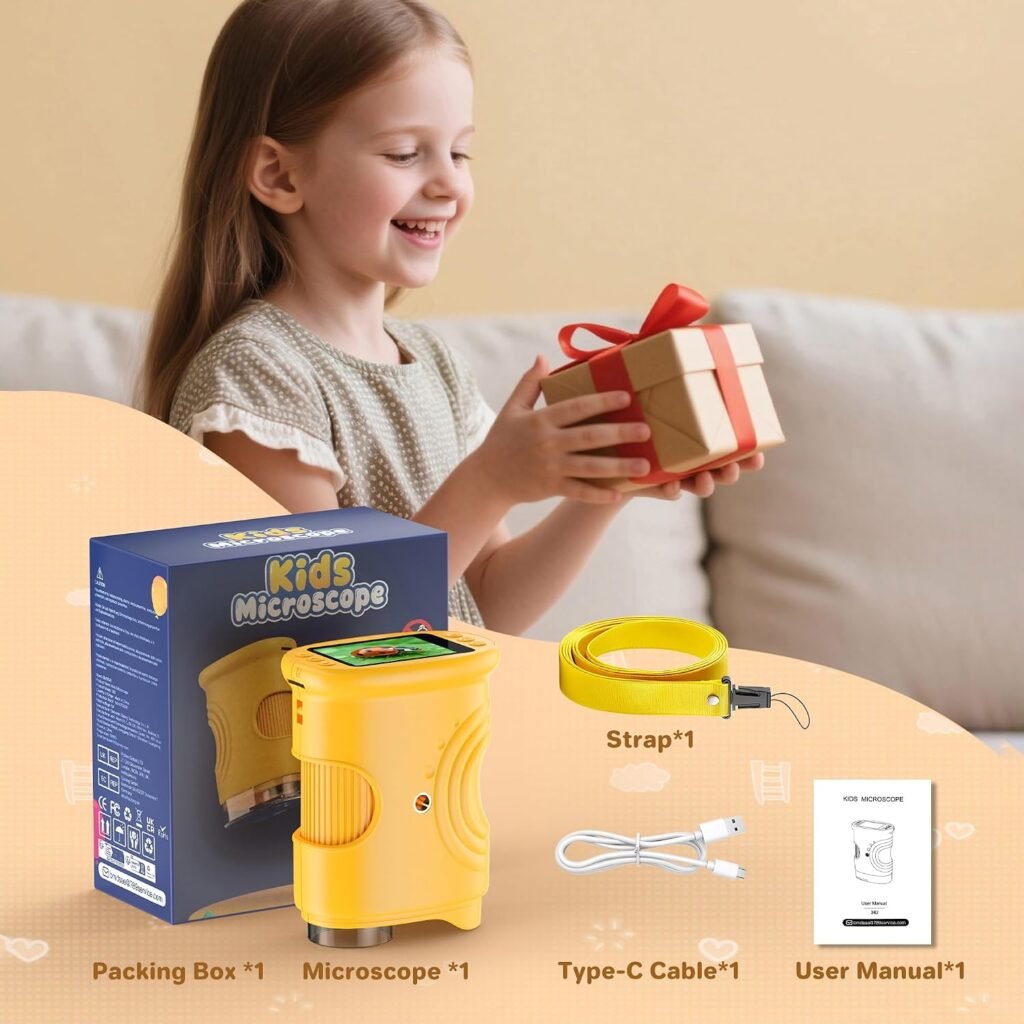
What Is Included?
Available product specifications list the main package as including items such as:
- Digital microscope
- USB-C cable
- Lanyard
- User manual
However, package contents can vary by seller or product variation.
Always check the exact Amazon listing before purchasing if accessories such as slides, storage cards or carrying cases are important to you.
Pricing and Availability
The product’s Amazon price can change based on seller, promotion, location and availability.
Third-party Amazon market-tracking data recorded prices around the high-$20 range during 2026, but these should not be treated as a guaranteed current price.
For that reason, the safest approach is to check the live Amazon listing before purchasing.
Check the Latest Price on Amazon
What Should You Check Before Buying?
Before placing an order, review these points:
1. Current Price
Compare the current price with similar kids’ digital microscopes.
2. Age Recommendation
Check the exact age recommendation on the current listing.
3. Included Accessories
Make sure you know whether slides, memory storage or other accessories are included.
4. Battery Information
Check the latest battery capacity and expected runtime.
5. Return Policy
Review Amazon’s current return conditions and the seller’s information.
6. Warranty
If warranty coverage is important to you, confirm the current warranty information before purchasing.
7. Product Variation
Different colors or variations can sometimes have different packages or specifications.
Is It a Good STEM Gift?
It can be a practical STEM gift for children who are genuinely interested in exploring how things look up close.
The strongest reason to consider it isn’t simply the “1000X” number.
It’s the combination of:
- A handheld design
- Built-in screen
- Camera
- Adjustable lighting
- Manual focus
- Rechargeable power
- Portable exploration
That combination turns everyday objects into opportunities for observation.
For a child who enjoys science, nature or discovering small details, that can make the microscope more interesting than a toy that has only one way to play.
Final Verdict
The 1000X Handheld Digital Microscope for Kids is designed around a simple idea: make close-up exploration portable and accessible.
Its most notable features include the 2.0-inch IPS display, up-to-1000X magnification claim, 2MP camera, manual focus, eight LED lights and rechargeable USB-C design.
Its biggest limitation is that buyers shouldn’t interpret the 1000X label as proof of professional laboratory performance. The actual usefulness of the microscope depends on optical quality, focus, lighting and the specimen.
For parents looking for a portable digital microscope for nature exploration, basic STEM activities, science projects or an educational birthday gift, it is a product worth investigating.
For advanced microscopy, a more traditional compound microscope may be a better fit.
Before purchasing, check the current Amazon price, age recommendation, package contents, seller information and return/warranty details.
Ready to see the current offer? Check the product listing before making your decision.