Starting an online business does not always require a warehouse, expensive equipment, or a large inventory. With a print on demand business, you can create custom products and sell them online while a production partner handles printing, packaging, and shipping after a customer places an order.
That makes print on demand an appealing business model for beginners, creators, designers, freelancers, entrepreneurs, and anyone who wants to build an online store around original ideas.
In this print on demand business guide, you will learn how the model works, how to choose a profitable niche, what products you can sell, how to create designs, how to choose a supplier, how to build your online store, how to price your products, and how to market your brand.
The goal is not simply to upload a few designs and hope for sales. A sustainable print on demand business requires a clear audience, useful products, strong branding, quality designs, smart marketing, and consistent testing.
What Is a Print on Demand Business?
Print on demand, commonly called POD, is an ecommerce model in which a product is produced only after a customer places an order.
Instead of purchasing hundreds of shirts, mugs, posters, notebooks, or other products in advance, you create or upload your design to a print on demand provider. When a customer purchases the product, the provider produces the item and handles fulfillment.
The basic process is:
Create a design → Add it to a product → List the product online → Customer orders → Provider prints and ships → You receive your profit
This model can reduce the need for inventory and printing equipment. Shopify describes print on demand as a model where products are produced after an order, allowing sellers to focus on design, branding, marketing, and customer experience while a supplier handles production and shipping.
Printful similarly explains that POD products are made after purchase and can be fulfilled without the seller holding inventory.
Why Start a Print on Demand Business?
One of the biggest advantages of print on demand is the ability to test product ideas without purchasing large quantities of inventory upfront.
You can experiment with different designs, audiences, and product categories and learn what customers respond to.
Some potential advantages include:
1. Lower inventory requirements
You generally do not need to purchase and store large quantities of finished products before you make sales.
2. Flexible product testing
You can test several designs and product types without committing to a large batch.
3. Remote-friendly business model
Because production and fulfillment can be handled by a third-party provider, much of the business can be managed online.
4. Creative opportunities
Print on demand gives designers, creators, and entrepreneurs a way to turn original artwork, slogans, illustrations, and branding ideas into physical products.
5. Multiple sales channels
Depending on your business setup and provider, you can sell through an ecommerce website or marketplace.
However, print on demand is not automatic income. Product costs, shipping, platform fees, advertising, refunds, taxes, design quality, competition, and customer service can all affect profitability.
Shopify notes that successful POD businesses still require work around niche selection, product quality, pricing, and marketing.
7 Powerful Steps to Start a Print on Demand Business
Step 1: Choose a Specific Niche
The first step in building a print on demand business is choosing a clear target audience.
A niche is a specific group of people with shared interests, needs, identity, lifestyle, or buying motivations.
Instead of trying to create products for everyone, think about a specific customer.
Examples include:
- Dog lovers
- Cat owners
- Fitness enthusiasts
- Travelers
- Teachers
- Nurses
- Gamers
- Entrepreneurs
- Book lovers
- Coffee enthusiasts
- Parents
- Students
- Outdoor enthusiasts
- Artists
- Pet parents
A specific niche can make your branding and marketing much easier.
For example, instead of creating a general “funny shirt” store, you could build a brand around humorous products for coffee lovers.
Shopify recommends choosing a niche to help define your target audience, products, and marketing strategy. It also suggests using search trends, SEO information, and social media trends when researching potential niches.
How to Research a Niche
Before creating dozens of designs, ask:
- Who is the target customer?
- What do they care about?
- What problems or interests do they have?
- What products do they already buy?
- What phrases or themes are popular?
- What competitors already exist?
- Can you create something meaningfully different?
Your goal is not necessarily to find a niche with zero competition.
Instead, look for a clear audience and identify opportunities to create better, more specific, or more memorable products.
Step 2: Choose the Right Print on Demand Products
Once you have a niche, decide what products you want to sell.
Common print on demand products include:
- T-shirts
- Hoodies
- Sweatshirts
- Mugs
- Posters
- Wall art
- Tote bags
- Hats
- Phone cases
- Stickers
- Notebooks
- Home décor
- Accessories
Different products work better for different audiences.
For example, a motivational brand might focus on posters, notebooks, mugs, and apparel. A pet-themed business might focus on shirts, mugs, tote bags, and accessories.
Do not launch with dozens of products simply because your supplier offers them.
Start with a small, focused collection.
A strong beginner strategy could be:
1 niche + 3 product categories + 10–20 quality designs
Then analyze which products and designs receive attention and sales.
Step 3: Create Original and High-Quality Designs
Your designs are one of the most important parts of your POD business.
A great product with a weak design can struggle to attract customers. A simple product with a strong, relevant design can stand out.
Your design process can include:
- Researching your target audience
- Creating original concepts
- Choosing appropriate typography
- Selecting suitable colors
- Creating illustrations or graphics
- Testing different layouts
- Creating product mockups
- Checking the design at different sizes
If you use graphics, fonts, photographs, templates, or AI-generated assets, always check the applicable commercial-use and licensing rules.
Do not build a business around copyrighted characters, logos, celebrity images, sports team branding, or other intellectual property that you do not have permission to use.
Originality matters.
Design for the Customer
Ask yourself:
“Would my target customer actually want to wear, display, or use this?”
That question is more useful than simply asking whether the design looks attractive.
For example, a hiking audience may respond better to a clever outdoor message than a generic motivational quote.
Your design should connect with the identity, interests, humor, lifestyle, or emotions of your target audience.
Step 4: Choose a Reliable Print on Demand Supplier
Your supplier is an important part of your business because customers will experience the physical product even though you may never manufacture it yourself.
When comparing POD providers, look at:
- Product quality
- Base product prices
- Printing methods
- Shipping costs
- Shipping destinations
- Production times
- Return policies
- Branding options
- Ecommerce integrations
- Product selection
- Customer support
- Sample-order options
Do not choose a supplier based only on the cheapest base price.
A cheap product that arrives late or has poor print quality can create unhappy customers and refunds.
Printful, for example, recommends ordering samples so sellers can check product quality, printing, packaging, and the overall customer experience before selling.
Order Samples Before Launching
One of the smartest steps in a print on demand business is ordering your own products.
Check:
- Print quality
- Color accuracy
- Product material
- Size
- Packaging
- Shipping time
- Overall presentation
You can also use your sample products to create your own photography and marketing content.
Step 5: Build Your Print on Demand Store
After choosing your niche, designs, products, and supplier, you need a place where customers can purchase your products.
You can use an ecommerce website or an appropriate marketplace.
Your store should have:
- A professional brand name
- A clear logo
- Easy navigation
- High-quality product images
- Clear product titles
- Detailed descriptions
- Pricing information
- Shipping information
- Return/refund policies
- Contact information
- Frequently asked questions
Your product pages should answer the customer’s most important questions.
For example:
What is the product?
Who is it for?
What size or variation is available?
What material is it made from?
How long will shipping take?
How should it be cared for?
What is the return policy?
A professional product page can make the difference between someone browsing and someone buying.
Step 6: Price Your Products for Profit
Pricing is one of the most important parts of your print on demand business.
A simple starting formula is:
Selling Price − Product Cost − Shipping − Platform Fees − Payment Fees − Advertising Costs = Estimated Profit
For example, imagine:
- Selling price: $29.99
- Product and printing cost: $12
- Shipping: $5
- Platform/payment costs: $3
- Marketing cost per sale: $4
Estimated profit:
$29.99 − $12 − $5 − $3 − $4 = $5.99
This is only an example. Your actual numbers will depend on your supplier, product, market, platform, taxes, shipping destination, and advertising strategy.
Do not set your price simply by looking at what another seller charges.
Calculate your actual costs first.
Consider Perceived Value
Customers do not always choose the cheapest product.
A strong brand, original design, high-quality presentation, niche relevance, personalization, and good customer experience can influence purchasing decisions.
Your goal is to create a product that customers believe is worth the price.
Step 7: Market Your Print on Demand Business
Creating products is only half the job.
People need to discover them.
Your marketing strategy can include:
- TikTok
- YouTube
- SEO
- Email marketing
- Content marketing
- Influencer collaborations
- Paid advertising
For a new business, content marketing can be especially useful because it allows you to demonstrate your products without depending entirely on paid advertising.
Pinterest Marketing for Print on Demand
Pinterest can be useful for visual products because people use the platform to discover ideas, products, inspiration, and solutions.
Create multiple useful visual assets for your products.
For example:
Pin title: “Funny Coffee Lover T-Shirts for Coffee Fans”
Pin description: “Discover creative coffee-themed apparel designed for coffee lovers. Explore unique print on demand shirts, gifts, and accessories for your favorite coffee enthusiast.”
Use relevant keywords naturally rather than repeating the same keyword excessively.
SEO Marketing
SEO can help people discover your products and educational content through search engines.
Create content around topics your target audience searches for.
Examples:
- Best gifts for dog lovers
- Funny teacher shirt ideas
- Best motivational mugs for entrepreneurs
- How to start a print on demand business
- Print on demand business guide
- Best print on demand products for beginners
- How to sell custom t-shirts online
Google recommends creating helpful, reliable, people-first content and using words that people actually use when searching for your content.
How to Build a Strong Print on Demand Brand
A POD store should be more than a collection of random products.
Build a recognizable brand.
Your brand can include:
- A memorable name
- Consistent colors
- Consistent typography
- A recognizable logo
- A specific customer
- A clear brand personality
- Consistent product photography
- Consistent messaging
For example, imagine a brand designed specifically for ambitious entrepreneurs.
Instead of selling random shirts, you could create a complete collection around:
Entrepreneurship + Productivity + Business + Motivation
That gives customers a reason to understand what your brand represents.
Create Product Collections
Collections can make your store easier to navigate.
For example:
Entrepreneur Collection
- Business mindset shirts
- Entrepreneur mugs
- Startup notebooks
Productivity Collection
- Productivity shirts
- Goal-setting notebooks
- Desk accessories
Motivation Collection
- Inspirational posters
- Motivational mugs
- Positive-message apparel
Collections can also give you more opportunities to create SEO-focused pages and marketing content.
Print on Demand Mistakes to Avoid
A beginner can make many mistakes when launching a POD business.
Here are some of the most important ones.
1. Choosing a niche without researching it
Do not spend weeks creating products before understanding your customer.
2. Uploading too many low-quality designs
More products do not automatically mean more sales.
Quality and relevance matter.
3. Ignoring intellectual property
Never assume that something found online is automatically available for commercial use.
4. Not ordering samples
You need to know what customers will actually receive.
5. Competing only on price
Low prices can make profitability difficult.
6. Using poor product images
Your product images are part of your sales presentation.
7. Ignoring customer service
Fast, professional communication can help protect your brand reputation.
8. Expecting instant results
A POD business often requires testing.
You may need to test different niches, designs, products, prices, images, keywords, and marketing channels before discovering what works for your audience.
Is Print on Demand Profitable?
Yes, a print on demand business can be profitable, but profitability is not guaranteed.
Your results can depend on:
- Product demand
- Niche selection
- Design quality
- Selling price
- Supplier costs
- Shipping costs
- Platform fees
- Advertising expenses
- Customer acquisition
- Repeat purchases
- Brand strength
The biggest advantage is that POD can reduce the need to purchase large amounts of inventory before sales. However, the per-unit cost can be higher than bulk manufacturing.
That means your business needs a pricing strategy that accounts for all relevant costs.
The objective should not simply be:
“Get more sales.”
Instead, think:
“Get profitable sales from the right customers.”
Print on Demand and Etsy
Etsy can be one possible marketplace for original print on demand products, but sellers need to understand its rules.
Etsy allows sellers to work with production partners, including POD services, when the products are based on the seller’s original designs or buyer customization. Etsy also requires sellers to disclose production partners where applicable.
This is important because using a POD supplier does not mean you can simply take commercially available products and resell them as your own designs.
Always review the current marketplace policies before listing products.
A Simple 30-Day Print on Demand Business Plan
If you are a beginner, you do not need to build everything in one day.
Use a simple 30-day plan.
Days 1–5: Choose Your Niche
Research your target audience, competitors, products, trends, and content opportunities.
Days 6–10: Research Products
Choose three to five product types that fit your audience.
Days 11–15: Create Designs
Create your first collection of original designs.
Days 16–18: Choose Your Supplier
Compare quality, prices, shipping, integrations, and policies.
Days 19–21: Build Your Store
Create your branding, product pages, policies, and navigation.
Days 22–24: Order Samples
Test the products and identify problems before launch.
Days 25–27: Prepare Marketing
Create Pinterest pins, social posts, product images, videos, and SEO content.
Days 28–30: Launch and Test
Publish your products and begin promoting them.
Track:
- Views
- Clicks
- Saves
- Add-to-carts
- Sales
- Conversion rate
- Product performance
Then use what you learn to improve the next collection.
Frequently Asked Questions
What is a print on demand business?
A print on demand business sells customized products that are produced after customers place orders. A third-party provider typically handles production and fulfillment, allowing the seller to focus on designs, branding, marketing, and customer experience.
Is print on demand good for beginners?
Print on demand can be suitable for beginners because it reduces the need to purchase and store large amounts of inventory. However, beginners still need to learn design, ecommerce, marketing, pricing, customer service, and product research.
How much does it cost to start a print on demand business?
Startup costs vary depending on your store platform, design tools, samples, branding, marketing, and other expenses. You can start relatively lean, but you should budget for the costs required to test products and market your business.
What are the best print on demand products?
Popular categories include t-shirts, hoodies, mugs, posters, wall art, tote bags, stickers, notebooks, accessories, and home décor. The best product for your business depends on your niche and target audience.
Do I need to keep inventory?
One of the main advantages of POD is that you generally do not need to purchase and store finished inventory before receiving orders. The product is produced after purchase by your fulfillment partner.
Can I sell print on demand products on Etsy?
Yes, Etsy allows production partners such as POD services under its rules when the products are based on the seller’s original designs or qualifying buyer customization. Sellers must follow Etsy’s current policies and disclose production partners where required.
How do I make money with print on demand?
You make money when the revenue from your sales exceeds the costs associated with products, fulfillment, shipping, platform fees, marketing, taxes, and other business expenses.
Is print on demand still worth starting?
POD can be a viable ecommerce model, but success depends on execution. A focused niche, original products, reliable fulfillment, strong branding, good product pages, and consistent marketing are more important than simply uploading a large number of designs.
Final Thoughts
A successful print on demand business starts with a clear customer rather than a random collection of products.
Choose a niche you understand. Create original designs that speak to that audience. Select products carefully. Work with a reliable production partner. Order samples. Build a professional store. Price your products based on real costs. Then promote your brand through SEO, Pinterest, social media, content marketing, and other channels that fit your audience.
Most importantly, treat print on demand as a real business rather than a shortcut to instant income.
Start small, test your ideas, study your results, improve your products, and build a recognizable brand over time.
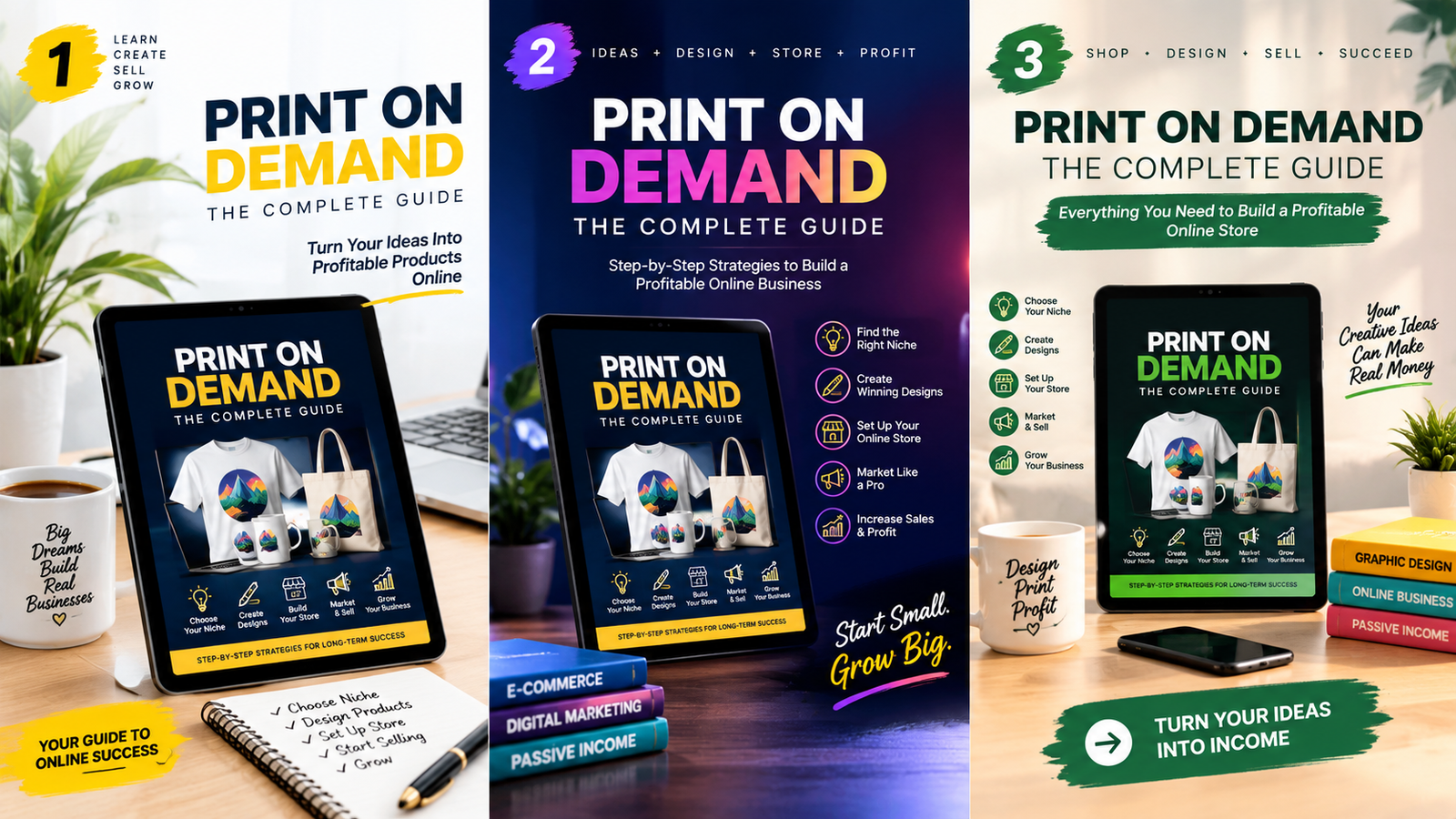
If you are looking for a practical resource to help you understand the business model, product research, branding, marketing, and growth strategies, the Print to Profit: Your Ultimate Print on Demand Business Guide E-book can be a useful next step for learning and applying these concepts.
Ready to turn your creative ideas into products? Start building your print on demand business one focused step at a time.
SEO & Publishing Checklist
Focus Keyword:
print on demand business guide
SEO Title:
Print on Demand Business Guide: 7 Powerful Steps to Start & Grow Your Online Store
URL Slug:
print-on-demand-business-guide
Meta Description:
Learn the print on demand business guide with 7 powerful steps to choose a niche, create products, build your store, market designs, and grow online.
Suggested Image Alt Text:
Print on demand business guide for starting and growing an online store
Suggested Image File Name:
print-on-demand-business-guide.jpg
Suggested Internal Links:
- Digital Products Guide
- Online Business Guide
- Pinterest Marketing Guide
- Canva Design Guide
- AI Business Guide
Suggested CTA:
“Ready to learn how to turn creative ideas into profitable products? Explore the Print to Profit: Your Ultimate Print on Demand Business Guide E-book and start building your POD business today.”